Art Along...
A city often has a scattered art gallery in its outdoor environment. Stockholm has a lot.
Look up. 1100 buildings from the 1600s until the 1930s have portals and facades decorated that reflect the mindset of the time. They are made in limestone, sandstone, marble, or grey stone.
Look ahead. A statue appears on the street. It might be interesting to pay attention to.
Go underground. The world's longest art
exhibition – 110 kilometers long – is open almost 24/7 in the metro.
Combine. The art along the walk with a shopping day. Within the same (almost) blocks.
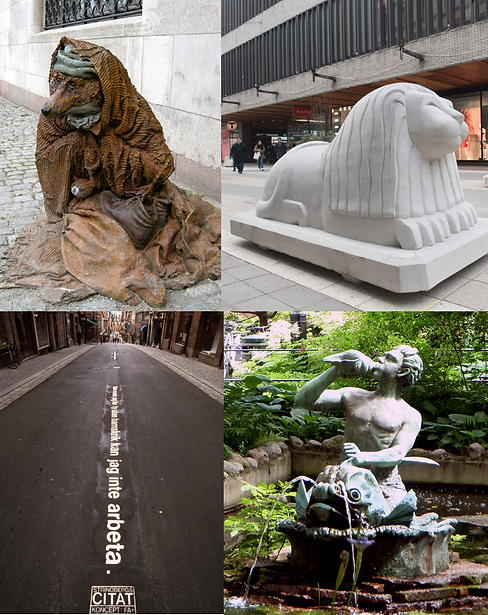
The Shopping Street Drottninggatan
When you walk on Drottninggatan from the south to the north, you find four artworks. Since 2009 a small fox sculpture Hemlös räv (Homeless fox) sits outside the Swedish Government House Rosenbad at the corner of street Strömgatan (the Current Street). It's a part of the British sculptor Laura Ford's (1961–) suite Rag and bone where forest animals find themselves in the vulnerable situations of the homeless.
The Swedish sculptor Anders Årfelt (1934–) designed the bright concrete cast lions that since 1995 serve as car stops along the pedestrian street. On 7 April 2017, one of the lions made an awful, sadly Islamist terrorist attack with a truck into a crowd more difficult. The year after, four new lions (each 4 tons) replaced the previous ones (900 kg) outside the department store Åhléns. Also, more lions were added on the street.
The quotes between Drottninggatan number 67 and 85 come from one of the mayor Swedish authors August Strindberg (1849–1912). He lived in a flat on number 85 for many years, which today is a museum. The artwork in stainless steel was created by Ingrid Falk och Gustavo Aguerre and was placed in the street in 1998.
The Central Bath Park (see webpage Baths) at Drottninggatan 88 is one of Stockholm's smallests parks. It's lovelly. Older, well-preserved properties (with one exception) surround it. The mansion Hårlemanska malmgården from 1710 is one of the few mansions from this time in the City. In the middle of the Park, there's the fountain sculpture Triton stands on a dolphin. It was modelled in 1923 by Greta Klemming (1893–1961), who was the daughter of the Bath's creator and architect Wilhelm Klemming.

The Artistic Metro
In the Stockholm’s metro 94 out of 100 stations have art of some kind. Over 250 artists have contributed from the 1950s to today. Each station is very unique. The artists have chosen their art themselves.
In seven centrally located stations, the art is replaced 1–4 times a year to focus on art that is being created today. Thematically, black and white images are shown at Slussen and Fridhemsplan, colour images at Gärdet and Zinkensdamm, photography at Mariatorget, art film at Skanstull and at Odenplan exhibitions of graduating students from Sweden's art and design academies.
Where to start? We suggest the fantasy-rich Kungsträdgården (King's Garden) station, which is close to the Old Town. The station's about 40 meters below ground. In 1977, the Swedish artist Ulrik Samuelson (1935–) created an underground garden with colourful abstract patterns that reflect the garden above ground. He made additions a decade later, inspired by the magnificent palace Makalös (Magnificent) above. Among all, there's a male and female torso that are casts of the art in the palace. It was built in 1635–1643 for the Swedish statesman and Count Jakob De la Gardie. Later, the palace became the theater Arsenalen, which burned down in 1825.
Then walk 900 meters to Östermalmstorg's station, which is 23 meters below the ground. Here, the theme is peace, women's and environmental struggles from the Swedish artist Siri Derkert's own heart issues. The work consists of 145-metre-long and 3.5-metre-high panels in natural concrete along both platforms. With the help of three artists, she sandblasted carvings: figures, family scenes, portraits of famous persons, notes (the International and the Marseillaise), and their own remember-marks (north on one of the platforms). After several years, they were finished in 1965. The metro became one of her most famous public works.
Take the tube one station to from Östermalmstorg station to Stadion station. The Swedish artists Åke Pallarp (1931–2013) and Enno Hallek (1931–) took the sky underground in 1973. Pallarp did one entrance with references to his sport interest: a poster of Sunshine Olympics in 1912 – the beautiful main arena built for this purpose is just above – and club badges from various bandy teams. The artwork of the letters S and M stand for the arena (Stadion) and the Academy of Music. Hallek made the Karlavägen entrance. At that time, he had a studio at Kungsträdgården and often passed the statue of the King Karl XII where he points (eastwards), hence the pointing sign.
The next station is the Tekniska Högskolan (the Technical University). Here, the Swedish artist Lennart Mörk (1932–2007) used the theme of technology, the four elements, and the laws of nature. Quotes from the history of science are interspersed with paintworks and sculptures such as Newton's apple, the wings of Icarus, and the five Platonic solids representing the classical elements – a dodecahedron, symbolising the aether and containing the "black hole of the universe", is suspended from the central ceiling. This station, as well as Stadion, is the first "cave stations" where the walls follow the contours of the underlying bedrock.
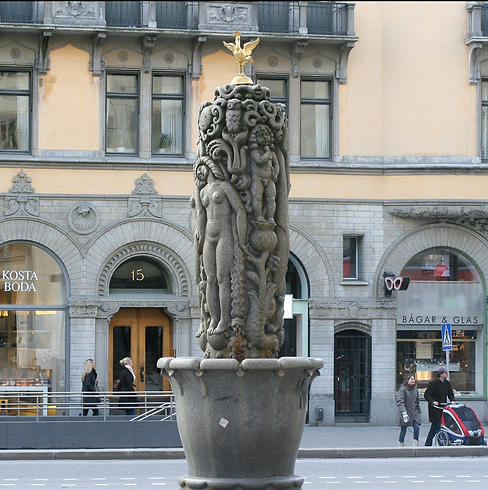
The Fountain of Eldh
When you walk between the metro-stations Kungsträdgården and Östermalmstorg for the art in the underground, look at the fountain made by the Swedish artist and sculptor Carl Eldh (1873–1954) in 1921. It’s at the corner of the streets Birger Jarlsgatan and Greve Turegatan.
Eldh created the statue after a competition announced by a private donation committee. He carved out three female figures – Morning, Day, and Night – from a vertical body in Swedish granite (this one is redish from the landscape Blekinge). He carved children in high relief between them. A bird in gilded copper crowns the work. The water in the fountain was meant to stand as a veil around the figures. Eldh wanted the work to depict "a bright idyll", and he valued the fountain as one of his most important works. However, a political debate started about its "phallic character" in 1922. Despite the reference, the fountain was allowed to remain.
Eldh was, along with Carl Milles (see the box below), the most popular Swedish sculptors in the beginning of the 1900s. His studio is used as a museum today. It’s untouched as he left it. Since 2010, the facility (house with garden) has the strongest legal cultural and historical protection available in Sweden.
The Iconic Towers
From the metro Östermalmstorg station, walk one kilometre to the square Hötorget (Haymarket, see box at page Shopping) on Kungsgatan (the King's Street). The architecture along this parade street is dominated by lavish buildings built mainly between the 1910s and 1930s. Here, the twin towers Kungstornen rises on either side of Kungsgatan. They were at the time Sweden's tallest skyscrapers with a height of 60 meters. Today, the towers are still an iconic sight in Stockholm.
The Swedish architect Sven Wallander (1890–1968) designed the north tower. The inspiration came from a study trip to New York where the division into plinth, middle section, and crest on buildings were found in lower (southern) Manhattan. The tower was completed in 1924.
The south tower, which was completed in 1925, was designed by the Swedish architect Ivar Callmander (1880–1951). Four top- sculptures came from Roman mythology: Fortuna, Mercury, Neptune, and Victoria). The Swede Aron Sandberg (1873–1959) made them. The Swedish telephone company L.M. Ericsson's (today's listed Ericsson) used it until 1940 as the representative headquarters of its real estate company. The sculpture Victoria holds a gilded Ericsson phone with the letters "LME".
The towers' load-bearing frame had reinforced concrete pillars. The façade became non-load-bearing made of plastered cement hollow stone. The construction method was completely new in Europe by the time. The granite on the lower parts of the two towers was the same as the adjacent bridge. Intricate details were made in the granite.
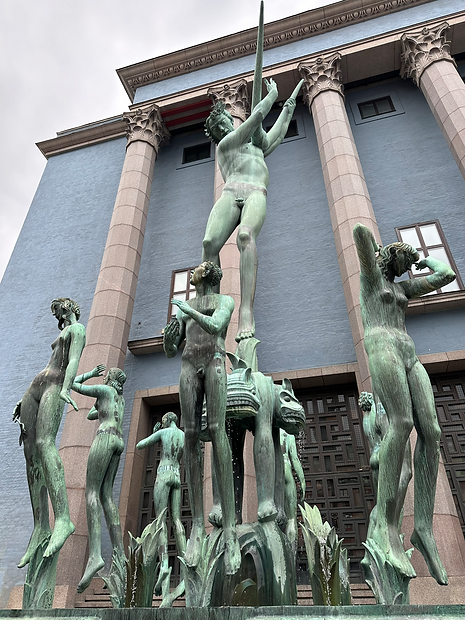
The Orpheus Well
In front of the beautiful, blue Stockholm Concert, at the corner of the streets Kungsgatan and Sveavägen, is an impressive bronze fountain sculpture. It was made in 1936 by the Swedish sculptor Carl Milles (1875–1955). The sculpture is called the Orpheus Fountain or Well and is 6 meters high. On page Art Galleries, there's some more information about Milles.
In the Well, Orpheus from the Greek mythology is portrayed as a singer and musician of rank. He descends into the realm of the dead to bring back his beloved Eurydice by playing the lyre.
With the power of the lyre alone, Orpheus lifts the group that surrounds him. The upward movement is enhanced by the fountain's sparkling water. Gravity is suspended. In the fountain, Milles has interpreted music's ability to elevate us above everyday life.
One of the inhabitants of the underworld, who is desperately raising his hands to heaven, has borrowed the features of the German composer Ludwig van Beethoven (1770–1827). This was no coincidence, Beethoven was for Milles symbol of the great, suffering artistic genius.
Inside the foyer of the Hall, Milles made the four muses of musical art playing on various instruments.