Short About Stockholm
Stockholm was founded in the 13th century and was built in the enclosure of the large fortification that the jarl (regent) Birger Magnusson – Birger Jarl – had built as a "lock" for lake Mälaren on the island Stadsholmen (the Islet of the city), on which the Old Town is located. On this island, two very important trade routes were crossed, the land route from north to south and the sea route from the outlet of Lake Mälaren (Sweden's third largest lake) into the Baltic Sea.
In July 1252, Birger Jarl issued two letters (letters of protection) that are dated in Stockholm. They are the oldest evidence for the name Stockholm. The name Stockholm is a combination of the words “stock” (log) and “holm” (islet), but what the name refers to is not unambiguous determined.
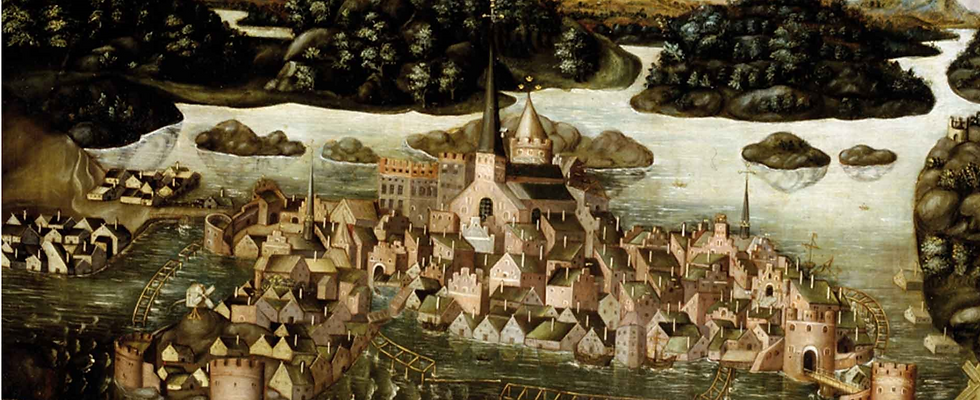
For several hundred years, the Old Town was Stockholm itself, but gradually the city expanded to include the surrounding islands and the mainland, which were referred to as “malmar” (ores). Malm roughly means sand or gravel and is related to the Swedish verb “mala”. It was a word that described the landscape of crushed stone that the inland ice left behind about 10.000 years ago, sometimes in the form of entire gravel ridges. Today, the verb is found in the city districts Södermalm, Norrmalm, Västermalm, and Östermalm.
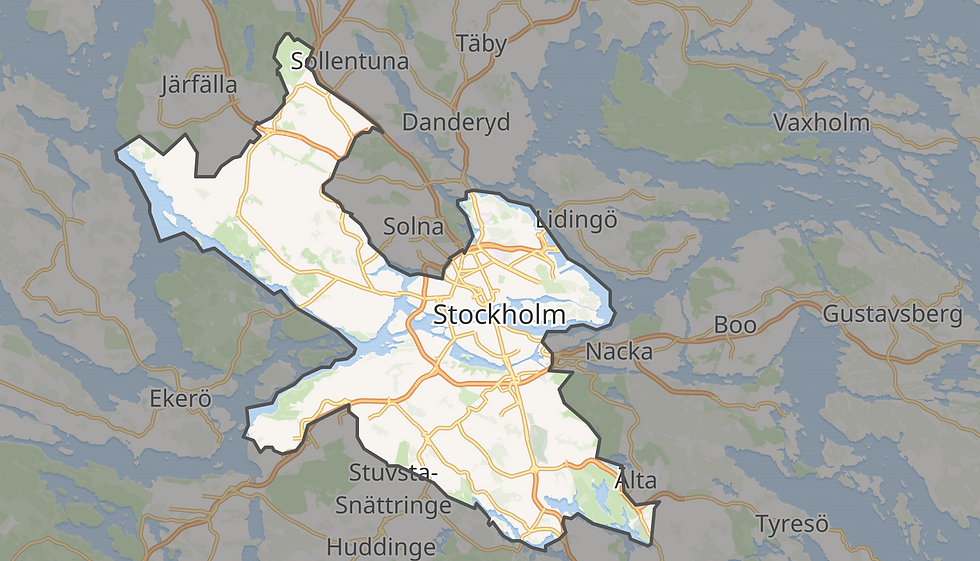
As Sweden's capital and largest city, Stockholm is the country's cultural, political, media, and economic centre. The municipality has close to 1 million inhabitants, but if you include the entire county, it will be over 2.4 million (2024). This corresponds to a quarter of Sweden's entire population.
Sweden is a constitutional monarchy where the political power lies with the general elected parliament, the Riksdag. The Government is appointed by the Riksdag and is dependent on its support. This form of government, parliamentarism, has been in operation since 1917 but was not enshrined in the constitution until the 1974. Since then the monarch's task was limited to representing the country.
The Swedish democracy is a representative democracy. This means that elected representatives make decisions in decision-making assemblies, i.e. the Riksdag, county councils, and municipal councils.
In the Council Chamber at Stockholm City Hall, the 101 elected members of the City Council (i.e. the municipal council of Stockholm) establish goals and guidelines for the City of Stockholm's activities. The members are appointed every four years when elections to the Riksdag, municipalities, and county councils are held. The party that receives the most votes gets the most representatives in the council and thus has a greater chance of influencing decisions. A representative on the municipal council is the same as a mandate.
An excerpt from “Vädersolstavlan” (the Weather Sun Tablet), the oldest known depiction of Stockholm. The original from 1535 is attributed to Urban Målare (Painter).
The municipality of Stockholm (2024).