The Emergence of Sweden
Sweden's unification as a kingdom was a lengthy process. Already in the first century after the birth of Christ, Roman writers spoke of the tribes of Svear (the Swedes) and Götar (Goths), who lived in present-day Sweden.
During the Viking Age and the early Middle Ages, Sweden consisted of a number of independent counties, loosely united under a common king. The highest decision-making body in the counties was the county council (or provincial assembly), where all adult free men could participate.
The first king who demonstrably ruled over both the regions Svealand and the interior of Götaland was Olof Skötkonung (died c. 1022). Historians set the unification of the two regions to the 11th century, at the same time the Viking raids eastwards subsided.
During the 1100–1500s Sweden began to take shape. Many believe that it was King Gustav Vasa who built Sweden, while others have the opinion that Birger Jarl was the founder.
The country became a great power in the northern Europe in the early 16- and 1700s. In 1809, Sweden was forced to hand over Finland to Russia. During 1814–1905 Sweden had a union with Norway.
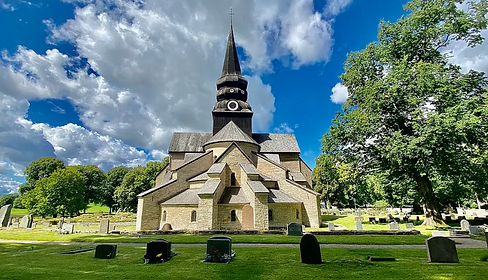
Birger Jarl took the power in the 1200s
Birger Jarl (real name Birger Magnusson 1210–1266) managed to become a close ally with the King Erik Eriksson. The Old Nordic title "jarl" was a title for the kingdom's highest official. On the death of the King in 1250, Birger Jarl's son Valdemar was elected as the new king (even if he was minor). Birger won the at the Battle of Herravadsbro in 1251 over opposing "big-families".
According to the Erik Chronicle (manuscripts from the second half of the 15th century), Birger Jarl founded Stockholm in 1252. He was able to build up a kingdom with the help of laws (among others several security laws) and tax systems. His tomb is in the Varnhems Monastery Church (dated 1148).
Birger's son Magnus Ladulås ruled after Birger Jarl (Valdemar was dismissed). When Ladulås died, a power struggle broke out between his three sons: Birger, Erik, and Valdemar. In the early 14th century, it threw the country into a bloody tangle of civil war and fratricide (Håtunaleken/Håtuna games och Nyköpings gästabud/the Nyköping Banquet).
When Ladulås's grandson Magnus Eriksson took the power, the situation stabilized. He was in power for almost 45 years. That's the second longest-reigning monarch in Sweden's history, surpassed only by the current King Carl XVI Gustaf.

Three Kingdoms form the Kalmar Union
In 1363, a group of Swedish noblemen wanted help to dethrone King Magnus Eriksson, whom they considered both stubborn and unfair. They asked the two German dukes Albrekts of Mecklenburg, both father and son, to help them. With the assistance of the German trade association Hanseatic League – the political and economic superpower in the Baltic Sea – the King was defeated. In 1364, Albrekt of Mecklenburg (the son) was elected King of Sweden.
By the end of the 1380’s, the noblemen were fed up with King Albrekt’s way of rule by absolute power. They asked Queen Margaret I of Denmark (1353–1412) for help. She inherited Denmark after her father King Valdemar Atterdag and Norway after her husband Håkan Magnusson (the son of the King Magnus Erikson) died. (Håkan inherited Norway after Magnus who inherited it after his grandfather.)
The Queen's army won over Albrekt in 1389. Thus, she had three kingdoms to rule. Her vision was to unite them in one personal union. Thus, she took her sister's grandson Bugislav from Pomerania as her foster son (her own son had died). He was crowned king in all countries (with the first name Erik). In 1397, his Swedish coronation took place at Kalmar’s Castle. Also, the Kalmar Union was formally established – the largest kingdom in Europe – with an united front against the Hanseatic League. The Queen ruled until her death in 1412.

Hereditary monarchy in Sweden from 1523
During the Kalmar Union, many noble families in Sweden preferred to be independent and not subject to foreign rule. Expensive wars and bloody settlements followed.
Gustav Vasa's war of liberation led to that Sweden left the Kalmar Union in 1523. Denmark and Norway continued to be a union until 1814. On 6 June 1523, Gustav Vasa was crowned King of Sweden (the date is the Swedish national day). He initiated the hereditary monarchy in Sweden.
In 1527, the King initiated the Reformation. Thus, Sweden went from being a Catholic country to a Protestant one. The king was head of the church instead of the pope. The action was a tool to centralize the Swedish state and improve its finances.
Gustav Vasa reigned 37 years. Taxes were introduced, foreign policy was pursued (due to economic opportunities), domestic political statutes were implementedt, and a government emerged. Sweden functioned as a united country.
Gustav Vasa was the unifying force and under his sons (he had four), Sweden's importance in Europe increased. Though, they fought among themselves for the royal crown. For five decades, Sweden was ruled by them in order: Erik XIV, Johan III, the grandson Sigismund (son of Johan III), and Karl IX.
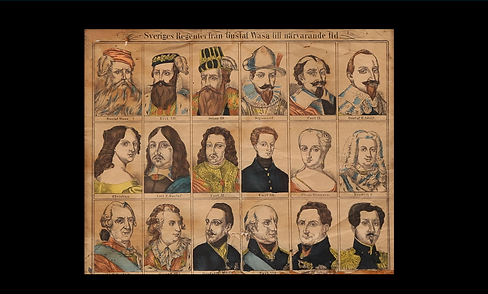
The Royal Houses that formed the Nation
The Vasa House ceased to hold the royal power when Queen Kristina abdicated in 1654, in favour of her cousin Karl X Gustav (whom she had appointed as her successor).
With King Karl X Gustav, the German Palatinate-Zweibrücken House had the Swedish crown. He was the first king during the Karolinska era (based on the theory of the kingdom by God's grace) and the autocracy that includes his own, the reigns of his son Karl XI and grandson Karl XII.
After the death of the King Karl XII in 1718, his sister Ulrika Eleonora became the Queen, but she handed over the throne in 1720 to her husband Frederik I and the House of Hesse. The couple never had any children together. The Estates' Parliament (information about the parliament in other boxes) had taken over the power – known as the Age of Freedom – from this period until the King Gustav III.
King Adolf Frederik succeeded Frederik I and thus the House of Holstein-Gottorp had the throne of Sweden. He became king through Russian pressure after the Russo-Swedish War of 1741–1743 to have a Russian-friendly king on the throne. After his son King Gustav III was assassinated 1792 at the opera house, his son became the King Gustav IV Adolf.
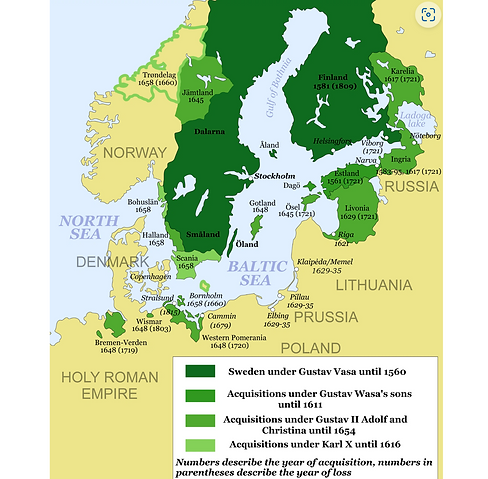
The Great Power Era 1611–1721
The Great Power Era is an epoch in Sweden's history. The period is often considered to begin in 1611 with the King Gustav II Adolf ascending the Swedish throne, but it was preceded by many wars that made Sweden an increasingly large nation in the Baltic Sea region. As Sweden grew larger, conflicts with other countries grew.
Between 1700–1721, Sweden was involved in the Great Northern War. Until the Battle of Poltava in 1709 (in today's Ukraine), King Karl XII (killed in 1718) and Sweden had defeated almost all opponents. At Poltava Russia was the enemy and the outcome was a military disaster for Sweden. In 1721, the peace treaty was settled where Sweden was allowed to keep Finland but was forced to give up the Baltic States. Sweden's time as a great power in northern Europe was over, and the position was taken over by the Russian Empire.
100 years after the Battle of Poltava, Sweden with the King Gustav IV Adolf had to give up Finland – after over 650 years – to Russia in the Finnish War. Thus, Sweden lost a third of its territory and a quarter of its population. Therefore, the King was deposed in a bloodless military coup d’état coup in 1809 and was exiled with his wife and children. Finland became part of the Russian Empire until its independence in 1917.

The Origin of a New House and a New Union
After the King Gustav IV Adolf was disposed (he died poor at the age of 58 in a rough Swiss inn in 1837), his uncle Duke Karl became the King Karl XIII (brother of King Gustav III). He was old and had no living legitimate heirs, so he adopted the Danish relative and prince Karl August. After a short stay in Sweden, the Crown Prince died.
After an election by the The Estates' Parliament 1810, the King Karl III adopted the French marshal Jean Baptiste Bernadotte (on the left painting) who was without any royal lineage of his own. One reason for this choice: he was to ally himself with Napoleon (supposed good contact between them), march on Russia, and retake the lost Finland. He didn’t.
When the former French marshal ascended the throne in 1818, he did so as Karl XIV Johan of Sweden and Norway – the two countries were in union thanks in part to his negotiations as crown prince. He became the ancestor of the present royal family.
Officially the United Kingdoms of Sweden and Norway (United Kingdoms) was a personal union of the separate kingdoms of Sweden and Norway under a common monarch and common foreign policy that lasted from 1814 until its peaceful dissolution in 1905.