The Grand Square
Stortorget (the Grand Square) is Stockholm's oldest square; simple sheds occupied the area in the late 13th century until they were destroyed by fire in the early 15th century. Traces of an older building are believed to date to 1024–1291.
From the 1300s to 1732, the Old Council Hall was located here. It was mentioned in 1330 in connection with fire ravaging. In the beginning of the 16th century, the Stockholm's Bloodbath happened here.
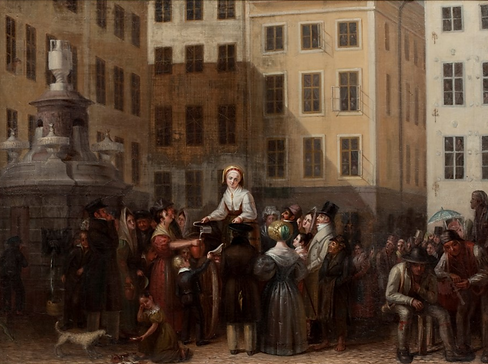
The Square is surrounded by old merchants' houses and the Nobel Museum. In the middle is the Stortorgsbrunnen (the Grand Square's Well). In 1833, a young girl became unwillingly famous here due to her beauty.

The Background to Stockholm's Bloodbath
In 1397, the kingdoms Denmark, Norway, and Sweden formed the political important Kalmar Union at Kalmar Castle. The Union was a mean to block the German expansion northward into the Baltic region. During the Union's final stages, a bitter power struggle was fought between the Danish King Christian II and the Swedish regent Sten Sture the younger (not related to Sten Sture the elder who “you met” at the dragon sculpture in the Great Church).
In February 1520, Sten Sture died in a battle against the Danes. In September, Christian II captured Stockholm, where he was crowned as King of Sweden (already King of Denmark and Norway) by Archbishop Gustav Trolle.
On November 4, 1520 many prominent guests had gathered for the coronation festivities at the Royal Palace of Stockholm. But after three days, everything changed. Archbishop Gustav Trolle had three years earlier been accused of high treason because of his association with the Danes, had been deposed as archbishop and had his castle Almarestäket (close to Stockholm) demolished by Sten Sture the younger.
Gustav Trolle suddenly began a lawsuit against those who had previously turned against him. Hastily, the conspirators were declared guilty of heresy and sentenced to death. The King had issued amnesty to Sten Sture's supporters, but the heresy accusation became an excuse to get rid of them. No amnesty for herectics.

The Stockholm's Bloodbath Took Two Days
Two bishops were the highest in rank and were the first of all to be executed on November 8–9, 1520. Then a long line of nobility, mayors, burghers and their servants followed – a total of about a hundred people. Gustav Vasa (1496– 1560) of the Vasa noble family, was not in Stockholm. His father Erik Johansson Vasa and several of his competitors were executed.
The nobles were beheaded – a noble privilege – at the Grand Square. Many other executed people were hanged. The dead bodies were burned (after some days on the Square) in a large bonfire on the island Södermalm, south of the Old Town. Also, Christian II exhumed Sten Sture the younger's buried body to be burned with the others. In Sweden, the people used the nickname Christian Tyrant to mirror all brutality.
Gustav Vasa travelled to the region Dalarna, where he organised a rebellion against Christian II. (Since 1922, the annual race Vasaloppet on cross country skies is a remembrance of this act.) Vasa made an alliance with Lübeck and successfully conquered most of Sweden. On June 6, 1523, Gustav Vasa was elected as the King Gustav I. The Kalmar Union ceased to exist.
In 1524, Gustav Vasa ordered a woodcut (to the left) of the Stockholm Bloodbath for propaganda purposes. It’s one of the oldest known depictions of Stockholm.

Warning Against Committing Crime
Stockholm has had many execution sites. What they had in common was that they were outside the urban settlement itself. Minor offenses were punished by shameful punishment, such as whipping, on the Grand Square. Executions were public events, but no one wanted the gallows next to their own house.
Between 1603 and 1776 there was a statue – Kopparmatte – on the Square. It was named after its material copper and the first statue’s look-a-like with the Mayor Mathias Trost at that time.
In 1647, a new statue was made with a raised whip in his right hand (denote the caning punishment). It stood on top of the square's pillory (shame pole) and was intended to serve as a warning against committing crimes. The foundry Gerdt Meyer made it after a model by the wood sculptor Martin Redtmer. Bronze was used as material instead of copper in the previous statue. Nowadays, the statue (the one from 1647) is preserved at the Stockholm's City Museum.
The last execution in Sweden was carried out on 23 November 1910 on the islet Långholmen with a guillotine. The death penalty in peacetime was abolished in 1921 (wartime in 1973).
Three Characteristic Houses
The red Schantzska House is named after the builder, Royal Secretary Johan Eberhard Schantz. It has a stepped gable of German-Dutch type, which is called “the Nordic Renaissance style”, decorated with anchor ends and sculptural details. The limestone portal is made by the German stone cutter Johan Wendelstam with lying Roman warriors.
The white stones on the façade of the Schantzska House is said to symbolize the heads decapitated in the Stockholm’s Bloodbath. Though, the House was built no later than 1479. The Royal Secretary got the House in gift by the councillor Bo Ribbing in 1627. The stones were added the following year.
In the 1620s, the yellow Seyfridtzska House (from 1520s) – next to the Schantzska House – was owned by the skinner Hans Seyfridtz. When he died his widow Maria remarried to Johan Eberhard Schantz. Both Houses got the same owner.
On the opposite side of the Square is the Grillska House (Number 3). It's named after the goldsmith Antoni Grill, who immigrated from Amsterdam to Sweden in 1659 and bought the House in 1681 (it dates back to the Middle Age). In 1912, the charity for homeless people in the city – Stadsmissionen – took over the House. It has a pastry in the ground floor.

The Nobel Museum – Prized Science
Since 2001, the Nobel Museum (the Nobel Prize Museum) is situated in the former Börshuset (the Stockholm Stock Exchange Building). If you stay in Stockholm for two days, you'll not have time to visit the interesting Museum – so just look at the exterior.
The Grand Square was a marketplace for trading in a variety of goods. From 1563, all trade should be conducted on Stortorget and not on the ore squares outside the Old Town. In the 1760s, the town's burghers and merchants decided about a building which was largely financed by an extra duty decided by the Estates' Parliament (more about the Parliament later). The building – the Stockholm Stock Exchange – replaced the Old Council Hall.
The exterior design comes from 18th-century French classicism, but somewhat Rococo style applied to the façade. In the middle is a clearly marked frontispiece and risalite. The Swedish architect was Erik Palmstedt, and the King Gustav III inaugurated it 1776. The Building was finished in 1778. In the interior, there're some very fine Gustavian style rooms entirely in gold and white.
In 1865, the town's burghers and merchants donated it to the City of Stockholm with a counterclaim: they should have eternal right of possession of a premise with three rooms.

The Swedish Academy for the Language
In the Nobel Museum, the Svenska Akademien (the Swedish Academy) uses the upper floor since 1914 (in perpetuity). This is due to a private donation from the philanthropist Magna Sunnerdahl who was one of the richest ladies in Stockholm at the beginning of the 1900s.
The Academy was founded in 1786 by King Gustav III. He was inspired by the French Académie française, with similar tasks, established in 1635. Sweden has over ten prominent Royal Academies (depending on how you count).
The Academy consists of 18 members and comprises the highest Swedish language authority. Prior to 2018 it was not possible for members to resign. It's motto is "snille och smak" (genius and taste). As established by the King Gustav III, its aim is "working towards the purity, strength and highness of the Swedish language".
Since 1901, the Academy has annually decided who will be the laureate for the Nobel Prize in Literature, awarded in memory of the donor Alfred Nobel. According to his will, the candidate should have bestowed "the greatest benefit on mankind" and written "in an idealistic direction". The guidelines have sparked much discussion and the Academy's choice of continent/country and gender have been criticized.
The Grand Square's Well House
Already in the Middle Ages, there was a well on the Grand Square. For many years, it was Stockholm's zero point, i.e. the point from which all distances for the kingdom's roads to and from the capital were measured.
In the 1700s and 1800s, wells were both vital and beautiful. They were not only necessary as a drinking water supply for Stockholm's residents, but also important for firefighting. The deputy city architect Erik Palmstedt designed many well houses in the city, including the one at the Square.
The well is made of sandstone and cast iron. It has four ejectors portrayed as water-spraying lion heads. The pump handles were made of wrought iron and finished with iron balls that resembled cannonballs. The round tower has "water" made of sandstone flowing from four holes. All of it is crowned by an urn. Palmstedt finished the well in 1778 – as he did with the Stock Exchange Building.
The well dried up in 1854, due to the groundwater level was lowered by the land uplift. (Annually, the land lifts about 5 mm due to the disappearence of the inland ice 10,000 years ago). In1857, it was moved to another square, but came back in 1953 for the Stockholm's 700th anniversary. The water in the well is tap water.
The Fever Around a Milk Saleswoman
The significance of Grand Square as a marketplace diminished gradually over time when other squares replaced it. From 1849, only milk was allowed to be sold. By this time, the Dalkulle fever had subsided. (Dalkulla is an older dialectal name for an unmarried woman from the region Dalarna north-east of Stockholm.) It was caused by the fact that everyone wanted to catch a glimpse of the beautiful milk saleswoman Carin Ersdotter (1814–1885) from Dalarna at the Square.
In 1933, she was employed at the farm Järla Manor in Nacka southwest of Stockholm by the noble Otto Wilhelm Staël von Holstein with the task to sell milk. At a time when newspapers became common, her beauty made her to Sweden's first internationally acclaimed media celebrity, and hysteria arose when admirers flocked around her – among them Crown Prince Oscar himself. She was forced to give up selling milk and made a living by showing herself at the home of Stockholm society.
In May 1934, Carin returned to Dalarna. Her fiancé no longer wanted to know about her. However, she found a new fiancé and married him in 1835. They had seven children and lived a life in poverty. At Järla Manor there is a street named after her (Vackra kullans väg). In 2005, a bronze sculpture of Carin (by the artist Peter Linde) was put in front of the Manor.