Storkyrkan (the Great Church)
The Storkyrkan (the Great Church or the Stockholm's Cathedral) is also called Sankt (Saint) Nikolai (Nicholas) kyrka from the saint of seafarers. It dates to 1279, when it is mentioned for the first time in writing and is the oldest church in Stockholm. It's said the regent Birger Jarl (the founder of Stockholm in 1252) financed it by gifts in 1264.
Since 1527, the Church has been a Lutheran Protestant church when King Gustav Vasa (1496–1560) introduced Protestantism in Sweden. The country had no tie to the Roman Catholic Church and the King became the head of the Church of Sweden. On January 1, 2000, the Swedish Church and the state was separated.
The Great Church has been used for royal coronations and weddings since the 13th century (the last coronation in 1873 and the last royal wedding in 2010).
Note: no big bags, prams, suitcases, or bagpacks are allowed into the church room.

The architecture
The first church was probably built of wood and is said to have burned to the ground. In 1306, St. Nicolai Church was consecrated (named after the patron saint of trade and shipping), and it has since been extended many times. It’s a five-aisled hall church built of brick.
The baroque design of the facades was a complete redesign carried out in 1736–42 with the Swedish architect Johan Eberhard Carlberg. At that time, the church basically got its current appearance on the outside. The exterior breaks with the Gothic design language of the interior.
Indoors, the buttresses have been designed as lisenas with a masonry technique where the stones have a rough-hewn, uneven surface to enhance the decoration and powerful appearance. The horizontal line of the masonry technique is reinforced by the strong cornice.
The tower is enlivened by quoins in the corners, pediments, and an ornate roof lantern. It's 66 meters high and there are four church bells hanging in it. Until 1909, the bells were rung by prisoners who were commanded to do so. Then electric motors were installed. If you're in Stockholm when the tower of Stockholm's City Hall is closed (off-season), do go up in the tower here (if it's opened) for a wonderful view.
Medieval masterpieces
The Great Church has two medieval masterpieces. The Seven Candlestick is a bronze candlestick that is almost four meters high. It was probably made in northern Germany in the 1400s. The late Gothic sculpture group Sankt Göran (St. George) and the Dragon is carved in oak that is hollow so as not to crack. It was created by Bernt Notke from Lübeck, but the information is uncertain. Regardless, experienced and skilled sculptors made it.
The Swedish regent Sten Sture (the elder) ordered the sculpture in memory of the victory at the Battle of Brunkeberg on 10 October 1471 close to the Old Town. Sten Sture led separatists from the Kalmar Union against supporters led by the Danish King Christian I. (In 1397, Denmark, Norway, and Sweden joined as a union.)
The sculpture shows an allegory: Sweden (St. George in the form of Sten Sture – the good) kills Denmark (the dragon in the form of King Christian I – the evil). The Princess represents Stockholm and the nation of Sweden. The statue was inaugurated with great solemnity on New Year's Eve 1489.
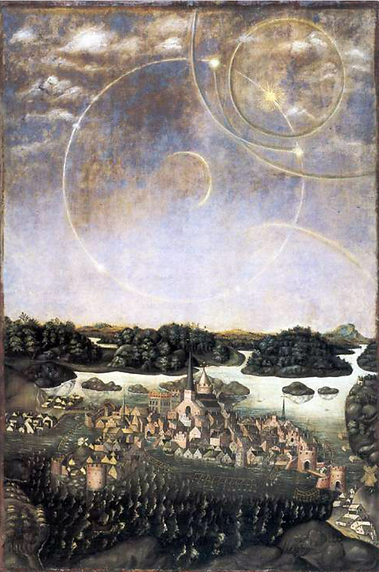
Vädersolstavlan (the Weather Sun Painting)
Vädersolstavlan (the Weather Sun Painting) is an oil-on-panel painting depicting a halo display, an atmospheric optical phenomenon, observed over Stockholm on 20 April 1535. The painting is noted for being the oldest depiction of Stockholm in colour, it is arguably also the oldest Swedish landscape painting.
The original painting, which was produced shortly after the phenomenon, is attributed to Urban målare ([the] Painter). Though, it is lost. This painting was made in 1636, or slightly earlier, and is a copy from the original made by Jacob Heinrich Elbfas.
The painting was produced in a political troubled time. In the Great Church, the reformer Olaus Petri ordered a painting of the weather phenomenon. The King Gustav Vasa interpreted it as critique against him. Petri was sentenced to death (not because of only the painting in itself). He was later pardoned and paied a heavy fine instead.
The Silver Altar
From the 17th century there is the unique baroque altar that was donated to the Great Church in 1652 by Johan Adler Salvius, Queen Kristina's closest advisor, and his wife Margareta Pedersdotter Skuthe.
The altar is a triptych made of ebony and silver. The sculpted reliefs are in ascending order:
-
of the Last Supper on the predella
-
the Crucifixion of Christ between silver statues of Moses and John the Baptist in niches with small silver columns on either side
-
of the Burial of Christ between silver statues of the evangelists Matthew and Mark
-
of Christ's Harrowing of Hell between statues of the evangelists John and Luke
-
on the pediment at top of the triptych, a silver statue of the Risen Christ between two reclining soldiers.
Queen Kristina abdicated two years later and converted to Catholicism. This was a major scandal at the time since her ancestor Gustav Vasa made Sweden protestant. She settled in Rome and came to play a prominent role in the city's cultural life. She was the daughter of King Gustav II Adolf and Queen Maria Eleonora. He ordered to build the ship Vasa in 1625 that you'll see in the Wasa Museum.