The Iron Square
On your walk from the Grand Square to the Järntorget (the Iron Square), you’ll see a statue of St. George and the dragon again. You also pass a famous, old restaurant: the Golden Peace. At the Square, the Swedish central bank used to have two buildings. Just a few steps away, Stockholm's narrowest street can be found. Nearby, you can buy traditional Swedish candy.
The oldest reliable evidence for the name Iron Square is from 1489. The name is related to the fact that the square became a storage place for mainly bar iron from the region Bergslagen. The iron was shipped for export from ports in Lake Mälaren to the city.

St. George and the Dragon – again
From the Grand Square, you continue the walk on Stockholm's oldest street, Köpmangatan (the Merchant Street), first mentioned in writing in 1323. The merchants had their stalls here as early as the Middle Ages. Today, this is a small street with several fun little shops.
At the end of the street, at Köpmantorget (the Merchant Square), you find a bronze and granite replica of the St. George and the Dragon in the Great Church. It was inaugurated on October 10, 1912. The date was set as memory of the Battle of Brunkeberg. The project was carried out through private funding from an association and the international Swedish manufacturer Hjalmar Wicander.
The wooden sculpture was copied under the well used sculptor (in public areas) Theodor Lundberg's supervision in clay and then cast in plaster, after which it was transferred in bronze by Otto Meyer's art foundry. The plinth was designed by the court curator Gustaf Lindgren.
The sculpture on the plinth extends all the way down to Österlånggatan (the Eastern Long Street). There is a fountain sculpture designed as a well with three medieval city gates through which water flows into the fountain basin. They symbolize the three streams that first surrounded the Old Town.

The Statue at the Iron Square
On the south-east side of Järntorget, outside the Södra Bankohuset (the South House of Banko), stands a statue of the singer-songwriter Evert Taube (1890– 1976). He is widely regarded as one of Sweden's most respected musicians and the foremost troubadour of the Swedish ballad tradition in the 20th century. He's perhaps best known as a depictor of the idyllic, with motifs from the Swedish archipelagoes and from the Mediterranean, from a perspective every Swedish four-week holiday tourist could recognize.
The statue was made in 1985 by the sculptor Karl Göte Bejemark. The location is suitable, as Taube's regular restaurant was Den Gyldene Freden (the Golden Peace). The restaurant is only about twenty meters away.
At the Iron Square is also Sundberg's patisserie, which was founded in 1785 and calls itself Stockholm's oldest. In the middle of the square stands one of Stockholm's few remaining public pumps from the 1800s (not in use).

The Golden Peace restaurant
The Golden Peace restaurant opened in 1722 at its current address. Thus, it’s one of the world's oldest continuously existing restaurants on the same site and Stockholm's oldest preserved city restaurant. Which "peace" the name refers to is not known.
The restaurant has been a popular hangout for well-known cultural people. The national "singer songwriter" Carl Michael Bellman, who lived during the 1700s, also visited Freden but was not a regular, it was Evert Taube who had his own table. In the early 1900s, the Golden Peace was also a "living room" for the Swedish art elite.
The restaurant has been owned by both men and women, all of whom were wine or cellar masters. In 1919, it was acquired by one of Sweden’s most famous painters Anders Zorn, who had it renovated and bequeathed it to the royal Swedish Academy. You "met" it on the Grand Square's Nobel Museum. The Academy still owns the restaurant. On Thursdays, its
18 members have dinner in the Bellman apartment, at least once a year they eat the traditional pea soup.
The South House of Banko
The South House of Banko was built between 1675 and 1735 for the central bank ”Riksens Ständers Bank” (called “Riksbank” from 1867). “Riksens Ständer” (Riksdag of the Estates) was the assembly of representatives from the four groups in the Swedish society: nobility, clergy, burghers, and peasants. It was the highest authority in Sweden next to the King from the mid-16th century until its dissolution in 1866 when Sweden got a bicameral parliament.
In 1668, the assembly took over the first bank in Sweden, which was privately owned, after it went bankrupt. Thus, the Swedish central bank is the world's oldest central bank. The assembly (later the parliament) owned it.
The house was built by the architects Nicodemus Tessin (the older), Nicodemus Tessin (the younger and son of the older), and Carl Hårleman. Both Tessin the younger and Hårleman designed the Royal Palace and Hårleman was the one who introduced the Rococo in Sweden.
The first construction measure was to reinforce the poor, filled out soil with 300 poles. The building's façade facing Järntorget reflects a clear application of the 17th century Roman palace style with three main floors and one recessed and one upper attic floor. Against the smooth plaster of the wall, a horizontal moulding is visible. The roof is designed as a manor roof covered in copper plates. The central bank moved in its first own house in 1680.
The North House of Banko
The North House of Banko was built in 1772 and designed by Swedish architect Carl Johan Cronstedt as a warehouse building for copper coin plates (they could be huge; Sweden produced the world's largest coin) for the central bank. For a period, banknotes were printed in it as well.
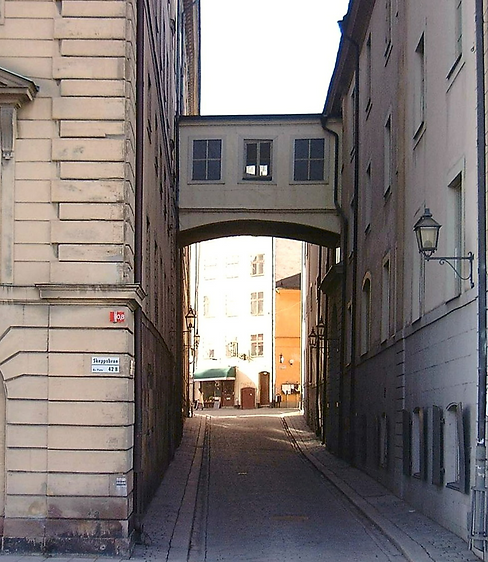
At the beginning of the 1800s, a footbridge was added at the height of the second floor between the North and South House of Banko. Originally, it was used to transport banknotes between the central bank's offices and the banknote warehouse. The nickname is "the Bridge of Sighs" because it's look-a-like with the same name bridge in Venice.
The Riksbank operated in the North and South buildings from 1680 to 1905 and then various government activities used them. The National Property Board owns the buildings that are currently rented out.
Today, the central bank is in its third building from 1976 (the second is the Riksdag building). The architect Peter Celsing and his co-worker Jan Henriksson designed it. The house is considered one of the most lavish, but also artistically most elaborate, works of modern Swedish architecture. You find in central Stockholm about 10 min walk from the Royal Palace.
Stockholm's narrowest street
On Västerlånggatan (the Western Long Street) – the Old Town's main street filled with shops – you’ll find Mårten Trotzigs gränd (alley). This is Stockholm's narrowest street with only 90 centimetres on the narrowest section. It's named after Mårten Traubtzich (in Swedish Trotzig) who immegraded from Germany in 1581.
Over time, Trotzig became one of the city's wealthiest merchants. He traded in iron and copper and bought the houses in the alley at the end of the 16th century. During a business trip in 1617 to central Sweden he was beaten to death. His widow Karin Trotzig continued the business.
The alley is in the neighbourhood called Trivia. Almost all the neighbourhood names in the Old Town were created in the latter part of the 17th century and are named after concepts (mainly gods) from Greek and Roman mythology. "Trivia" is the Latin name for Hekate, who in Greek mythology was the goddess of moonlight, sorcery, and ghosts. She had three heads: a dog's head, a snake's head, and a horse's head.
The alley has given its name to Restaurant Mårten Trotzig, which is located on Västerlånggatan where Mårten Trotzig's alley ends.

Traditional Swedish Candy
Gamla Stans Polkagriskokeri (cookery) makes the traditional candy stick polkagris (plural: polkagrisar). It’s color is white and red, the flavour is peppermint.
It remains a well-known albeit old-fashioned candy in Sweden, often sold at fairs, Christmas markets, and the like. Genuine Polkagris has had a protected geographical indication since 2022. Thus, it must be manufactured in the southern Swedish town Gränna to be called Polkagris. (Though, the owner of Gamla Stans Polkagriskokeri comes from the town.)
Why Gränna? There's an explanation: Amalia Eriksson (1824–1923). She was a poor 35-year-old widow who got the town council's permission to open a bakery to make pastries and peppermint rocks to support herself and her family. Her shop was in Gränna. She invented the candy in 1859 and kept the recipe secret. After her death it was revealed.
The odd name means "polka pig". "Polka" refers to a lively Slavic swirling dance which was still a novelty when the candy was invented. The dance is still a common genre in Swedish folk dance and folk music. The name may recall the way a traditional polkagris is made, twisting red and white sugar dough ribbons. (In the shop in the Old Town, you can see how they make it.) The word gris (pig) was at that time used as an expression for candy.