The Luminous City
From May to July, the Nordic light is present in Stockholm with its long twilights and dawns. It's a magic time. Then, the dark nights appear again. The illuminated City creates a mystic atmosphere.
Some illuminated artefacts are well-known signatures in the night-sky. The first neon (from the old-Greek "new") billboard was put up 100 years ago (in 1924) by the Swedish newspaper Dagens Nyheter. It doesn't exist anylonger, but the NK-Clock does in the middle of Stockholm. Here, the artwork the Obelisk stands out during the night. Close to the Old Town, the retro sign Stomatol breathes a bygone era.
From the end of November until mid-January, Christmas lights make the City sparkling. The Christmas tree in the Old Town is visible from a long distance. In mid-December there's a light festival on different buildings around the City. With a great portion of luck, you can see the Northern Lights on the sky.

The NK-Clock – a Landmark in the City
The NK-Clock on the NK Department Store doesn't only measure time in the middle of Stockholm. It's Sweden's first outdoor neon sign. The landmark can be seen almost everywhere in the City.
The rotating Clock was installed in 1939 on the 45-metre-high telephone tower (near NK) for marketing purposes. The technical engineer firm ASEA made it with the participation of the Swedish designer and inventor of illuminated advertising Ruben Morne (1917–2007). When the outdated telephone tower was demolished in 1953, the Clock was put on the NK roof.
The Clock's dial was (is) 7,6 meters in diameter and it weighted 7 tons. It had red neon tubes for the Clock-side and green for the NK-logo. The unchanged logo was designed in 1902 by the Swedish interior designer David Blomberg (1874–1962). It took (takes) 15 seconds for the Clock to spin a lap.
The Swedish architect Hans Asplund (1921–1994) designed the spiral staircase around the 25 meters high mast up to the Clock. In 2012, the 92-metre-long neon tubes were replaced with LED technology with a similar appearance (see film).
The Obelisk as a Central Reference Point
When you walk to the shopping street Drottninggatan from the NK (or vice versa), you pass another central, luminous landmark: the 37.5-metre-high glass pillar Kristallvertikalaccent from 1974 made by Edvin Öhrström's (1906–1994). It has many nicknames such as Pinnen (the Stick) or Glasobelisken (the Obelisk). You can walk under the fountain Sergelfontänen to see it from beneath.
The Obelisk weight 130-tons and is made of a steel frame clad with 60,000 glass prism from Lindshammar Glasbruk (Glassworks). Here, three people worked full-time for about three years with all prisms. In 1993, it got illuminated from within (LED-based lighting 2017) as the artist wanted.
The Obelisk stands at the major public square in the City centre: Sergels torg (the Sergel's Square). It was finished 1968 with a roundabout in the middle. The name comes from the influential Swedish sculptor Johan Tobias Sergel (1740–1814) who had a workshop north of the Square at Sergelgatan 1 (where you find a sculpture bust of him).
The lower part of the square, with the nickname Plattan, is about 10 meters below the ground level of the old buildings that were demolished in the mid-1900s. The square manifests the demolition fury of the central City (see the box below).
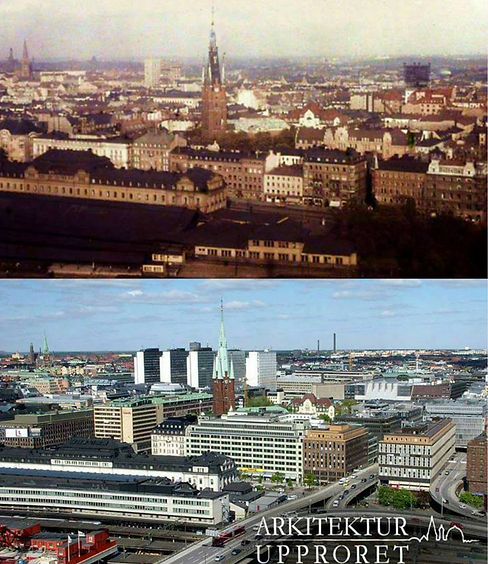
The Demolition Fury in the City Centre
In the 1800s and early 1900s, the area around the Klara Kyrka (Church) – called the Klara area or the lower Norrmalm district – was characterized by old, cheap housing, workshops and many small shops. The area was known for being home to several Swedish newspapers, bars, and cheap hotels.
In 1945, the Stockholm City Council decided to carry out the Norrmalmsregleringen (the redevelopment of Norrmalm). It was a major revision of the city plan for this area. The result: over 700 buildings, or 50 per cent, of the buildings had been demolished during 1950s–1970s. At the same time the Stockholm subway was built.
This was the largest Swedish urban development project to date. It engaged a large part of Sweden's leading banks, insurance- and construction companies, and architectural élite. It’s regarded as one of the larger and most full-of-character of all city renewals in Europe in the aftermath of World War II, even including the cities that were severely damaged during the war.
Behind the enormous transformation project (see film here and here) was a futuristic ideology of the time time. Politicians, architects, and the social engineers were caught in rationality thinking. Also, property owners and construction companies were blinded by profit maximization. The old buildings just had to go. They had no value no matter how beautiful or well-built they were. Room was needed for the future: shopping, offices, and cars. Later, the project became scolded by many people. Today, it's a representant of that time.
The Retro Stomatol Sign
The Stomatol Sign is Sweden's first animated commercial display and the oldest still working. It represents a toothbrush and a toothpaste tube of the Swedish brand Stomatol. It was first erected in 1909, on the Katarina Elevator at the Slussen-area (the Lock), by the company Såpasjuderiet Grumme & Son. Since 1933, the sign has been placed on a nearby property behind the Elevator. The display was designed by the inventor and artist Mauritz Larsson (1869–1928) and consists of 1361 25 W light bulbs in the colors red, yellow, and white.
The Katarina Elevator is worth some words too. It's Stockholm's most famous elevator and an iconic landmark for Slussen. The designer behind this structure, with an open steel shaft of 38 metres and a 154-metre-long footbridge, was the Swedish engineer Knut Lindmark (1838–1892). At the start 1883, the price was 5 öre for the ascent and 3 öre for the descent collected by a conductor who drove the elevator. In 1915, an electric engine replaced the original steam engine that powered the elevator. The Elevator has been fully renovated two times.
The tasteful Gondolen is under the footbridge and it’s Bar Zeppelin above it. The view over Stockholm is wonderful from here. Almost at the end of the bridge is the Södra Teatern with its live music and view as well.
The Giant Christmas Tree
Since 1996, the giant Christmas Tree appears on Skeppsbron (the Shipbridge) in the Old Town. It’s lit on the first day of Advent until mid-January.
The idea to place the impressive Christmas tree here came from the Swedish financier Jan Stenbeck (1942–2002). He was founder of the investment company Kinnevik AB and one of the most successful entrepreneurs in Sweden in the late 20th century. His inspiration came from the large, classic Christmas tree outside the Rockefeller Center in New York. Kinnevik AB held shares in the forestry company Korsnäs AB from which land the spruce came from. It was placed in front of the investment company's head office on Skeppsbron. Nowadays, Kinnevik AB pays for the construction work, while the paper producer Billerud AB delivers the trees.
The Christmas Tree is manipulated. It’s made with a long trunk as a foundation from a spruce that is 130–150 years old. It’s transported to Skeppsbron without branches. Wires like sailboats' make it steady. 1000 branches from real spruces are attached to the trunk. With the star at the top, the hight is about 35–38 meters.
The Light Festival for Ideas
Nobel Week Lights is an annual light festival since 2020 during the Nobel Week in the beginning of December. It celebrates the power of ideas that change the world. With light installations inspired by Nobel Prize awarded discoveries and achievements the festival offers a cultural experience that is free and accessible to everyone during the darkest time of the year.
The festival is presented by the Nobel Prize Museum and invites both international and local artists, designers, and students to create large-scale public light artworks in Stockholm. During the festival around sixty guided tours are offered in six different languages.
The Aurora Dance
Experiencing the Northern Lights, or Aurora Borealis, is a magical and unforgettable sight. This natural light dance in the sky is most visible in the polar regions near the 70 degrees latitude. The Aurora occurs when charged particles from the sun collide with the Earth's atmosphere. It’s present at all times of the year and at all hours of the day. But to see the it, certain conditions are required, such as dark skies, clear weather and strong solar activity. The greatest chances to see it are during late autumn and early spring (around the autumn and spring equinoxes) between 9–11 pm.
The Aurora is sometimes visible further south such as in Stockholm – or a better place is to be outside the City. From the Pearl Cottage we have seen about 1–2 Auroras per year (but we are not out late every night).
There are apps for the Aurora forecasts that give an indication of it, but you should still not trust them completely. Although low probability, it may be visible in the sky. If you want to be surer to see it, head north. A genuine, magical place is Låktatjåkko Mountain Lodge a short distance from the village Björkliden. You can get there by train (with or without flight to the town Kiruna). The train station ahead is Abisko Mountain Lodge. It's a very nice place for the Aurora. Or the Ice Hotel in the village Jukkasjärvi close to Kiruna.