The Slope of the Palace
Slottsbacken (the Slope of the Palace) is a street in the Old Town that looks more like a square ending by the Baltic Sea. New, lavish stone houses were built opposite the castle Tre Kronor (the Three Crowns Castle) during the 1600s when Sweden became a Great Power in northern Europe. The Slope was one big construction site after the Castle burned down in 1697 and during the Royal Palace was built.
When the Palace was completed in the mid-1700s, the Slope had been transformed into the monumental place it is today. The buildings sights we highlight in the Slope are: the Obelisk, Tessinska palatset (the Tessin Palace) and Finska kyrkan (the Finnish Church).
When you walk towards Storkyrkan (the Great Church) you´ll find the Oxenstiernska palatset (the Palace of Oxenstierna) just outside. Remember Oxenstierna until you come to the Square of the Knights almost all round the Old Town.

The Obelisk
Modern obelisks are commemorative monuments of past glories and a symbol of state power. Their roots are in the ancient Egyptian culture, where they were placed in pairs at the entrance of the temples. The word "obelisk" is Greek.
The obelisk on the Slope was commissioned by King Gustav III to show his gratitude to the town's burghers and merchants who guarded Stockholm while the King was leading the Swedish Navy and Army in the Russo-Swedish War. The King Gustav IV Adolf unveiled the obelisk in October 1800.
In 2017, the original obelisk was dismantled due to age- and weather-related damage and was rebuilt in spring 2020. It's nearly 30 metres high, including the pedestal of 5 metres.
The design of the obelisk was made by the French painter and artist Louis Jean Desprez. It was erected by the Swedish inventor and colonel-mecanicus Jonas Lidströmer. who handled its complicated construction at the time; it weighed 150 tons and was made up of different pieces of Swedish granite
On the obelisk there is the name of King Gustav IV Adolf, which is not to be read on any other public memorial in Stockholm. When he was deposed, his name was obliterated everywhere where it was found in public places except on the obelisk. Why? Find out in the box about the Great Power Era.
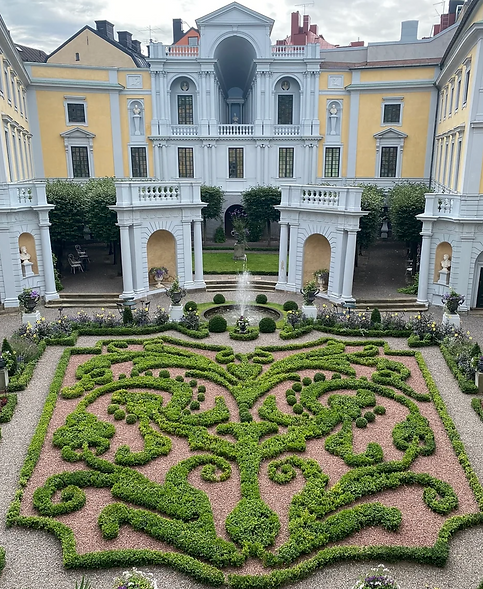
Tessinska palatset (the Tessin Palace)
In 1692, the Swedish architect Nicodemus Tessin the Younger (1654–1728) bought a plot (street Slottsbacken 4) opposite the castle Tre Kronor (the Royal Palace). Since his father's death in 1681, he became both city and castle architect to King Karl XI.
Tessin managed to transform the relatively small and irregular plot to a building with a garden that is perceived as symmetrical and that followed the principles and rules of the Baroque architecture of the time. The Palace has, according to the Parisian model, three functions: a courtyard (cour d'honneur), the main building (corps-de-logi), and then an Italian baroque garden (jardin) in miniature.
The trick was that he removed the irregularities of the plot with wings of different widths and heights. He created illusory perspectives so that both the palace and the garden felt larger than they were. The facades facing the courtyard were richly and imaginatively decorated. The Palace was finished in 1701.
When Tessin died in 1728, the Palace was inherited by his son Carl Gustaf Tessin, who was then forced to sell it in 1755 (bad economy). A few different owners passed by until the City of Stockholm bought the property in 1773. It is currently used as a county residence for the County Administrative Board of Stockholm and is not open to the public.

Finska kyrkan (the Finnish Church)
The Finnish Church (in Finnish Suomalainen kirkko on the street Slottsbacken 2 B–C) is not well known, but in its backyard there is a statue: the Iron Boy from 1959 by the Swedish sculptor Liss Eriksson (1919–2000). It’s Sweden's smallest statue (14 cm) and has become a real tourist magnet. One reason for this may be the customs around the figure; on cold days, visitors like to put a hat on the little boy or put a scarf or jacket around him.
The Finnish society in Sweden did not have its own church from the 16th century. In 1725, the Finnish congregation got the opportunity to acquire Lilla Bollhuset (the Little Ball House). The building had been built between 1648–1653 by the Swedish architect Georg Sippel as an extension to the Great Ball House. The King Frederik I made the purchase possible.
Previously, the Little Ball Househad been used for ball games by the members of the court and as a court theatre by travelling theatre companies. The Swedish architect von Göran Adelcrantz transformed it into a church. He was a pupil and later a collaborator of Nicodemus Tessin the Younger. The church was consecrated on December 19, 1725.

The Important Statesman
Lord High Chancellor Axel Oxenstierna (1583–1654) was one of Sweden's most important statesmen of all time. He was a high nobility, the teacher of the King Gustav II Adolf (1594–1632) during his childhood, and later the King's closest collaborator. He became de facto regent in 1632 when Queen Kristina (1626–1689) was a minor due to the King's death in a major battle.
Oxenstierna formed the Swedish state apparatus and government agencies, such as the Swedish Post Office in 1636, and got them to cooperate. He had the country divided into counties of equal size with fixed county boundaries that are largely still in force.
Oxenstierna had a palace built next door to his workplace the Tre Kronor Palace (later the Royal Palace) on street Storkyrkobrinken 2. The architect was the same as the House of Nobility's: the French-Swedish Jean de la Vallées (1624–1696). The Palace is considered to be the first palace in Mannerism style in the city. Every second floor has a low mezzanine, which gives the façade a characteristic look. The façade is made in a rough-hewn sandstone and plaster with the original colour red.
The palace was completed in the 1650s, but the Oxenstierna family never lived due to his death soon after the "build-start".