The Square of the House of Knights
Riddarhustorget (the Square of the House of Knights) is named after its location in front of the beautiful Riddarhuset (the House of Knights/Nobility). Nextdoor is the Bondska palatset (the Bonde Palace) from the same time and taste. Two bloody events happened here around the 19th century.
The Riddarhuset is literally translated as House of Knights as the knights is in Swedish "riddare". It was built in 1641–1674 and it can be seen as a symbol of the nobility's position of power during this time. Since 2003, the House is an organisation owned and managed by a private association of the 657 living nobility families.
The tradition with a Swedish nobility might go back to the Viking Age. Its position was formalized in 1280 by King Magnus Ladulås (Magnus Barn Lock – a nickname). The nobility did service to the monarch: making horses or foot soldiers available in war against no need to pay taxes. If no financial means to do the service, tax had to be payed.

The Exterior of the House
The land where the House of Nobility is situated was purchased byLord High Chancellor Axel Oxenstierna (1583–1654). He donated it to the Swedish nobility as a meeting place during the Riksdag of the Estates (1527–1866). You got some information about this Riksdag on the Iron Square, and you've some more at the Parliament building. None of the other estates had a meeting place.
The House is the work of several architects who succeeded each other: Simon de la Vallée (killed by a nobleman), the Dutch Justus Vingboons, and Simon’s son Jean de la Vallé. It was designed in Renaissance style and (except for the roof) quite closely copied after the building Mauritshuis in the Hague. Though, many details are taken from the Italian architecture of the time.
The two-part roof with a curved lower profile formed the model for the typically Swedish manor roof. The main façade in light Gotland sandstone and local brick has recessed columns in Corinthian order. In 1870, the House got free-standing wings designed by the Swedish architect Adolf W. Edelsvärd (1824–1919). He was the chief architect for the Swedish State Railways and designed, for example, the lovely Central Station of Stockholm.
The Gallery of Statues
On top of the central risalites on the House of Nobility are statues of sandstone:
-
the south side – (facing the square) the female figure represents Nobilitas, the nobility
-
the north side – an ancient warrior with a knight's chain (probably represents the Knighthood) flanked with Prudentia (the female personification of the virtue) and the Roman mytological Hercules (represents heroism).
On each side of the ridge there are personifications of the motto of the House of Nobility Arte et Marte (art as peaceful work and war), two areas where the nobility considered themselves to have special tasks in the service of society. Arte is represented by the Roman goddess Minerva, who in this form wears a cross in addition to a book. The four obelisks that stand in the corners of the upper landing serve as chimneys.
The south end of the building carries the Latin inscription Claris Maiorum Exemplis ("after the clear example of the forefathers") and holds a statue of the King Gustav Vasa (1523–1560). North of the building is a park in which is a statue ofLord High Chancellor Axel Oxenstierna (1583–1654).
Inside the House of Nobility
The House of Nobility was one group (of four) in the Riksdag of the Estates (1527–1866). In 1611, the House had exclusive rights to the highest offices in the kingdom and it became an institution in 1625. The King Gustav II Adolf and the Lord High Chancellor Axel Oxenstierna regulated it in 1626.
In 1866, Sweden got the bicameral parliament through the so-called representation reform. Thus, the nobility lost its last political influence, although individual members of the nobility still had a great deal of influence due to their contacts in royalty, state, and business, while continuing to be some of the wealthiest landowners in the kingdom.
The last person to be knighted was the Swedish explorer Sven Hedin, who was knighted in 1902 by King Oscar II. The monarch's right to knighthood ended in 1974.
Inside the House, there're 17th century interiors and a monumental stairwell with stairs in limestone from the Swedish island Öland. In the Hall of Nobility hang 2337 coats of arms. The number on them show the introduction year of the lineage in the House. The lower the number, the earlier introduction (the 100 lowest numbers were drawn in 1625). Everyone who belongs to a noble family is a member.
Bondska palatset (the Bonde Palace)
The noble Gustav Bonde was appointed national treasurer in 1660. He helped to put the state finances in order after many years of war, during King Karl XI's reign. The Bonde family marked their social position by building a Palace (started in) 1662. Gustav Bonde died in 1667 and his widow Anna Kristina Persdotter Natt och Dag had to complete it in 1673.
The Palace was designed by the most renowned architects of the time: Nicodemus Tessin the Elder and Jean de la Vallée (the architects you probably already "met"). They were strongly inspired by the French Baroque and Renaissance styles. The façade of the Palace was decorated with pilasters, festoons and Roman imperial images.
After Gustaf Bonde's death and the reduction, the family's finances deteriorated. The Palace came to be rented out for various purposes. Among the tenants were the Swedish National Library/National Archives and the Svea Court of Appeal (later moved to the Wrangel Palace), both of which lacked premises after the Three Crown Castle fire in 1697. The City of Stockholm bought the Palace in 1730. Thereby, the Old City Council moved here from Stortorget (see the Nobel Prize Museum). After almost 200 years, in 1915, the Council moved to a new built building on the islet Kungsholmen.
In 1948, the Palace was transferred from the city to state ownership (the National Property Board of Sweden) with the Supreme Court being the tenant. (This Court was established by the King Gustav III in 1789.) Parts of the Palace are open to the public during Supreme Court hearings.

The Punishment of a King-murderer
The noble Jacob Johan Anckarström (1762–1792) was a captain in the Swedish army and is known as the King Gustav III's murderer.
Several members of the nobility saw their privileges curtailed by the King and were dissatisfied with his politics. Anckarström also had a personal hatred of the King. They conspired against the King and his own theatre, the Gustavian Opera House, was chosen as the crime scene. (It was built in 1782, but 110 years later it was replaced by the Royal Opera).
On 16 March 1792, Anckarström shot the King during a masquerade ball at the Opera. The King lived thirteen days. He ordered that everyone involved (about 40 people) were pardoned for life – except the murderer. Anckarström was sentenced to shame and death penalty. The composer Verdi’s opera Un ballo in maschera is based on this terrible event.
The shameful punishment was carried out by painful caning in three different squares, on three different days, of which the Square of the House of Knights was one place. The beheading took place on April 27, on the island Södermalm. His family took the name Löwenström and through donations laid the foundation for the Löwenström hospital outside the city.
The Murder of a Famous Diplomat
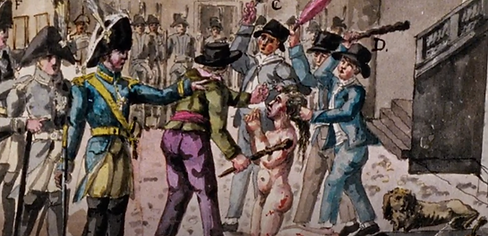
On the Square of the House of Knights the Marshal of the Realm and noble Axel von Fersen the Younger was brutaly murdered on 20 June 1810. He was an international famous Swedish diplomat, statesman, and a friend (no proof of lovers but evidence of mutual attachment) of Queen Marie-Antoinette of France.
Before the murder, the Sweden's King Gustav IV Adolf was deposed in a bloodless military coup d’état coup on March 13, 1809 after Sweden's loss of Finland – after over 650 years – to Russia in the Finnish war. His uncle, Duke Karl, Karl XIII became the king. He was old and had no living legitimate heirs. A Danish prince was chosen as heir to the throne – Crown Prince Karl August – and he became popular.
Fersen and his sister Sophie von Fersen previously worked to make Gustav IV Adolf's son as heir to the throne. When the Crown Prince suddenly died, the nobles who deposed Gustav IV Adolf had strong reasons not to want to see the deposed King's son as heir. A rumour was spread that the Crown Prince was poisoned by Fersen.
On 20 June 1810, the Crown Prince's funeral procession passed through Stockholm. Fersen joined and was torn from his marshal's carriage. A large and angry crowd lynched him to death in front of soldiers from the Svea Life Guards who were there to maintain order. Actually, Fersen was innocent.